
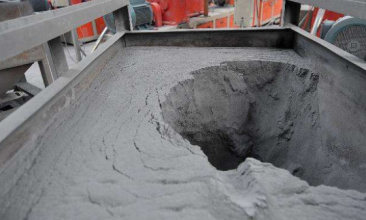
Effect and function of fly ash in concrete
(1) Temperature peak reduction and morphology effect
Fly ash can significantly reduce the temperature rise caused by cement hydration. Because of its incorporation, the amount of cement in concrete is correspondingly reduced under the condition of keeping the total amount of cement in concrete unchanged. As a result, the hydration heat of cement decreases, and when the content of cement increases, it decreases more. Although it will produce pozzolanic reaction in concrete to release hydration heat, this reaction lags behind the cement hydration reaction in concrete, and the time is also very long, so the reaction heat can be ignored. Therefore, fly ash has a good temperature peak reduction effect, which can reduce the concrete cracking caused by excessive temperature rise and improve the volume stability of concrete. The vast majority of fly ash particles are glass spheres. Adding fly ash into concrete can reduce the internal friction, thus reducing the water consumption in concrete, and improve the concrete pore structure. The pore diameter is continuously refined, and the tortuosity of the pore channel is increased. Therefore, fly ash concrete has good anti permeability.
(2) Volcanic ash activity effect and adsorption
Fly ash particles contain active SiO2 and Al2O3, which continuously absorb Ca (OH) 2 generated by cement hydration to generate hydrated calcium silicate and hydrated calcium aluminate, and produce secondary reaction with free lime and high alkalinity hydrated calcium silicate to generate low alkalinity hydrated calcium silicate with higher strength, better stability and more quantity, improve the composition of hydrated cementitious substances, and reduce or eliminate free lime, In addition, a large amount of C-S-H gel produced during hydration of fly ash concrete will absorb and fix a large amount of na+, k+ and chloride, which greatly reduces the content of effective alkali and chloride ions in concrete pore solution, thus effectively inhibiting the alkali aggregate reaction and reducing the corrosion of chloride ions.
(3) Micro aggregate filling effect
The filling property between cement particles is not good, and the average particle size is usually 20~30 μ m. The average particle size of fly ash (grade I and II) is smaller than that of cement, and the average particle size of ultra-fine fly ash is 3~6 μ m。 Therefore, if fly ash is added into cement, the filling property of cementitious material particles can be greatly improved and the density of cement paste can be increased. The relative density of pure fly ash is smaller than that of cement. When replacing cement with similar fineness and weight, it can increase the content of fine particles. These particles fill the voids between cement particles and at the interface, making the structure of cement paste and interface more compact. At the same time, the hydrated calcium silicate C-S-H gel generated by the pozzolanic reaction of the active component in the fly ash can fill the capillary pores in the cement stone and block the permeability channel, thus greatly improving the impermeability of the concrete. In this way, it is difficult for water and corrosive media to enter the interior of the concrete, thus greatly improving the durability of the concrete. The above effects or functions play a synergistic role, which greatly improves the durability of concrete.